
Understanding Elevator Code & Safety Requirements for New Construction Homes
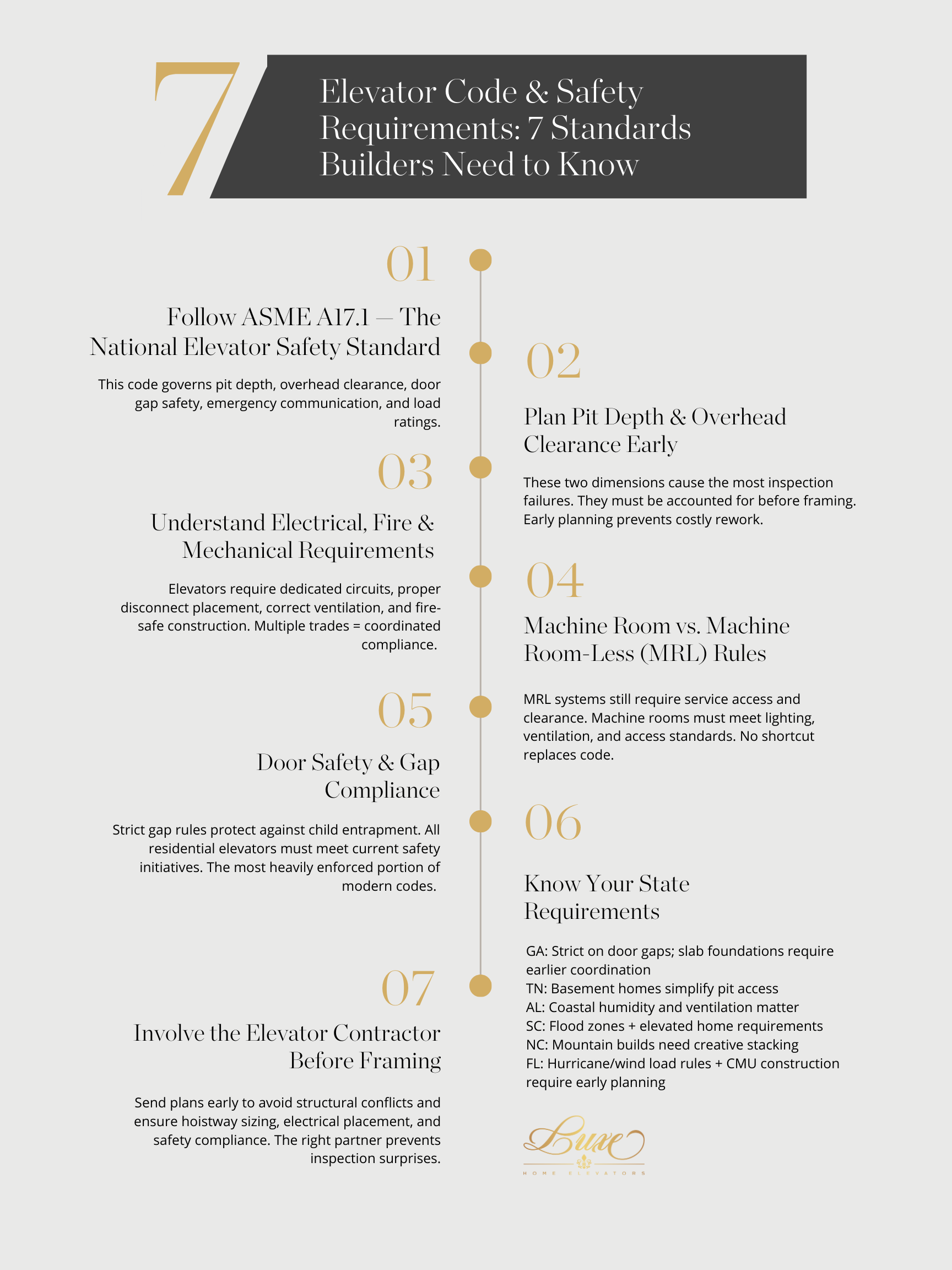
Residential elevators have become a standard feature in luxury and multi-level homes across the Southeast. But for builders, architects, and developers, an elevator is more than a convenience — it’s a regulated piece of equipment that must be installed with strict compliance to safety and building codes.Understanding these requirements early prevents costly redesigns, failed inspections, and project delays. Below is a builder-friendly guide to the most important elevator codes and safety standards for new construction homes.
1. ASME A17.1 — The Core Safety Standard
The primary code governing residential elevators in the United States is ASME A17.1 — Safety Code for Elevators and Escalators. Every state in the Southeast adheres to this standard.
Key ASME A17.1 requirements builders must be aware of:
Pit Depth: Minimum depth varies by elevator style; typically 6–12 inches for most residential models unless a shallow-pit system is used.
Overhead Clearance: Required distance between the top of the cab and the shaft ceiling to ensure safe operation and stopping space.
Door Gap & Entrapment Safety: Strict guidelines governing the space between the elevator gate and landing door to prevent child entrapment.
Emergency Communication: All residential elevators must include two-way communication accessible without a phone.
Load Ratings: Cab size and weight capacity must comply with residential designation limits.
Builder Tip:
Most code violations occur because pit depth and overhead clearance weren’t planned before framing. Early communication with the elevator installer avoids rework.
2. Fire, Electrical & Mechanical Considerations
Residential elevators involve multiple trades. Ensuring code compliance means coordinating early across disciplines.
Fire & Smoke Safety
Fire-rated doors may be required depending on home layout.
Smoke detectors must not be located inside the shaft.
Fire blocking around the hoistway must meet local building codes.
Electrical Requirements
A dedicated 110V or 220V circuit depending on system type.
Correct placement of the disconnect switch per ASME.
Adequate lighting in the shaft and machine spaces.
Mechanical Requirements
Proper ventilation in shaft or machine area.
Clearance for service access.
Hydraulic systems (if used) must have containment and protection.
Builder Tip:
Electrical disconnects are one of the most common inspection failures — they must be easily accessible and labeled according to code.
3. Machine Room vs. Machine Room-Less (MRL) Codes
Not all elevators require a machine room — but code still governs where equipment can be installed.
Machine Room Systems:
Require dedicated mechanical spaces with clearances that meet ASME.
Must comply with ventilation, lighting, and access requirements.
Machine Room-Less Systems (MRL):
Equipment is placed in the hoistway.
Still requires proper clearance for service technicians.
Shaft structural design and access points must meet specific code tolerances.
Builder Tip:
Never assume MRL = “no space needed.” Service access is strictly regulated.
4. Door Safety & Gap Compliance
Door safety is one of the most important aspects of residential elevator code.
Requirements include:
Maximum allowable gap between the landing door and elevator gate.
Interlocks ensuring the elevator cannot move unless doors are fully secured.
Protection against child entrapment — a major national safety initiative.
Builder Tip:
Using approved, pre-engineered door systems is the fastest way to pass inspections and avoid liability.
5. State-by-State Code Requirements Across the Southeast
While ASME A17.1 sets the national standard, each Southeastern state enforces the code slightly differently. Here’s what matters most for builders in each region:
Georgia
Strong enforcement of the elevator door gap safety rules.
The State Office of Insurance and Safety Fire Commissioner oversees inspections.
Elevators must be permitted and inspected prior to operation.
Builder Focus:
Ensure early pit and overhead clearance planning — slab foundations make adjustments harder later.
Tennessee
Tennessee applies ASME A17.1 with state-specific permitting.
Most new construction homes have basements or crawlspaces, making pit access easier.
Builder Focus:
Basement homes must still meet pit waterproofing and drainage requirements.
Alabama
State inspection is mandatory, especially in coastal zones.
Newer homes require strict compliance with door safety measures.
Builder Focus:
Plan for additional humidity considerations near coastal areas — ventilation is key.
South Carolina
Overseen by the SC Elevator & Amusement Ride Safety Division.
Heavy coastal and flood-zone construction means unique lower-level considerations.
Builder Focus:
In elevated homes, shaft structural integrity and wind-load compliance are important.
North Carolina
NC enforces ASME A17.1 rigorously with county-level oversight in some regions.
Heavy mix of mountain, coastal, and suburban builds.
Builder Focus:
Mountain homes often require creative shaft stacking to meet overhead clearance.
Florida
One of the strictest elevator regulatory environments due to hurricane codes and coastal engineering.
CMU/concrete block construction requires very early shaft integration.
Builder Focus:
Elevators should be positioned away from exterior walls subjected to wind loads.
Storm-resistant equipment and backup power considerations may apply.
6. Passing the Final Inspection
Common inspection checkpoints include:
Correct pit depth and overhead clearance
Door interlock functionality
Emergency communication testing
Proper disconnect labeling
Safe travel with no rubbing, grinding, or obstruction
Verified compliance with door gap regulations
Builder Tip:
Most issues arise from framing done before the elevator team reviewed plans. Always send drawings early.
7. Why Early Collaboration With the Elevator Contractor Matters
The elevator installer should be involved before framing.
This allows:
Correct shaft sizing
Correct landing alignment
Proper electrical rough-ins
Compliance with state-specific requirements
No structural surprises on inspection day
At Luxe Home Elevators, we partner with builders and designers across the Southeast to review plans, advise on code requirements, and ensure your elevator is compliant long before the inspector walks through.
Final Thoughts
Understanding elevator code isn’t just about compliance — it’s about protecting the homeowner, the builder, and the entire project timeline. When you design with code in mind, the installation is smoother, faster, and inspection-ready from day one.